I’ve been looking at post-Soviet architecture for decades, it’s still broken by the prolonged Soviet rule with its central imperative. It’s generational trauma, and it will take two or three more generations to recover from it: the sense of visual taste of all these people, previously cultivated over centures, was effectively stomped out, and they need to acquire it anew, which takes time and effort. The deeper you go into Russia, the worse it gets, but the ripples are seen far and wide. I posted some examples here. That last pic you provided is like a little baby compared even to your original photo from Bratislava.
If you want to see some really bad shit, check out Luzhkov’s style and capitalist romanticism. Those are prime examples of the looks being dictated by people who have money but no taste, and this has been going on through the nineties-zeroes, having been barely attuned in the 2010s by some hints of attention to modern Western architecture. And low-rank officials on the ground, responsible for painting the buildings, are certainly much less likely to read ‘Architectural Digest’.
That’s because the picture above is from Malmö.
It is true that Sweden is more conservative in its painting schemes, you call it probably more tasteful. But I think it shows that it is a gradient.
I never experienced that “Soviet trauma” yet rather disagree on your analysis of Petrzalka. This patchwork colour style isn’t a function of soviet trauma, it is rather what those large commie block districts with long and tall buildings need it in order to break up the scale into something more humane. Both, horizontally and vertically. Modern blocks are not built like that, they are also generally not coloured like that. Different building typologies work better with different colouring schemes. And no, Panelaki are no failures, those are often pretty popular places to live actually, when properly maintained, also on the inside.
I find that style … servicable. It could be just as easily be in Bratislava or Vienna, or somewhere in Germany for that matter. In the same colour scheme too.
PS: examples of Luzhkov’s style and capitalist romanticism from Russia are pretty terrible, they don’t exist in Slovakia to my knowledge, Moscow is further away from Bratislava than Stockholm if I am not mistaken. Not just geographically.
Those look pretty cool to me, as they resemble old European districts and seem also to work similar to townhouses like those in NYC. The paint scheme is also much better than in the Bratislava example, breaking up the block but not patchy.
Curiously, I’ve seen some new builds in Russia that are of typical block scale, but clearly inspired by modern European styles. These are way better than those still affected by the post-Soviet aesthetic and remainders of the aforementioned caprom malaise. Russia has the oddity that current regulations don’t quite allow denser low-rise districts, so developers inevitably gravitate to big blocks, but at least some of them apparently strive for better looks. E.g.:


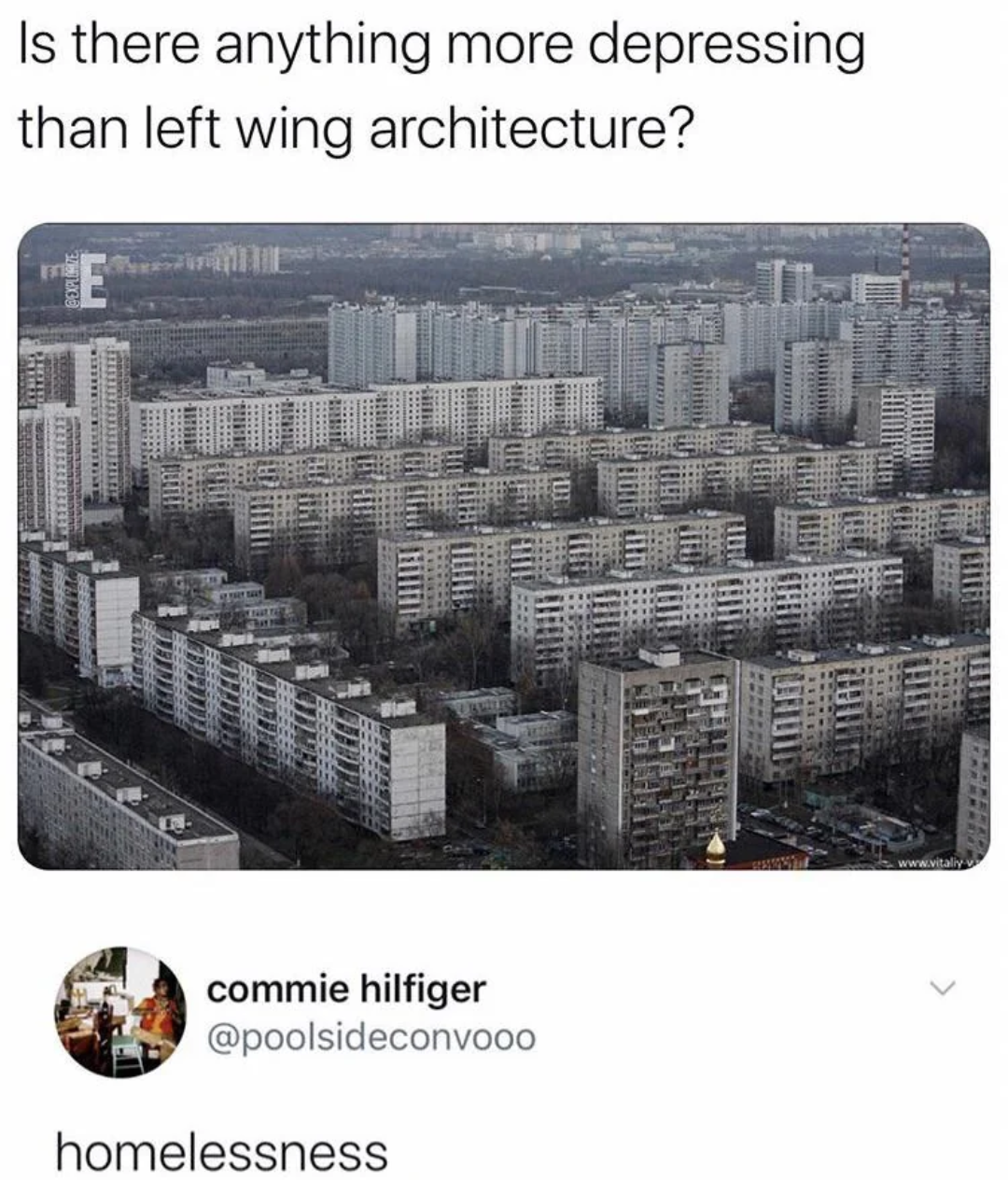
I’ve been looking at post-Soviet architecture for decades, it’s still broken by the prolonged Soviet rule with its central imperative. It’s generational trauma, and it will take two or three more generations to recover from it: the sense of visual taste of all these people, previously cultivated over centures, was effectively stomped out, and they need to acquire it anew, which takes time and effort. The deeper you go into Russia, the worse it gets, but the ripples are seen far and wide. I posted some examples here. That last pic you provided is like a little baby compared even to your original photo from Bratislava.
If you want to see some really bad shit, check out Luzhkov’s style and capitalist romanticism. Those are prime examples of the looks being dictated by people who have money but no taste, and this has been going on through the nineties-zeroes, having been barely attuned in the 2010s by some hints of attention to modern Western architecture. And low-rank officials on the ground, responsible for painting the buildings, are certainly much less likely to read ‘Architectural Digest’.
That’s because the picture above is from Malmö. It is true that Sweden is more conservative in its painting schemes, you call it probably more tasteful. But I think it shows that it is a gradient.
I never experienced that “Soviet trauma” yet rather disagree on your analysis of Petrzalka. This patchwork colour style isn’t a function of soviet trauma, it is rather what those large commie block districts with long and tall buildings need it in order to break up the scale into something more humane. Both, horizontally and vertically. Modern blocks are not built like that, they are also generally not coloured like that. Different building typologies work better with different colouring schemes. And no, Panelaki are no failures, those are often pretty popular places to live actually, when properly maintained, also on the inside.
There are of course differences in styles in Sweden vs Slovakia among contemporary buildings. Sweden has some of the better modern architecture in Europe. Vienna for example, which is just across form Bratislava, has a lot of the worst looking (even though it has been massively shaped by Swedish urban planning). Bratislava is actually no worse than Vienna probably better looking (even if probably worse building qualityas such). Things are not as clear cut. These detached blocks here in Lund: https://www.google.com/maps/place/Malmö,+Schweden/@55.7167554,13.2314728,123a,35y,57.74h,60.1t/data=!3m1!1e3!4m6!3m5!1s0x465305a574c491ff:0xd3a905dfbd4888e5!8m2!3d55.604981!4d13.003822!16s%2Fm%2F011l894y?entry=ttu&g_ep=EgoyMDI2MDQwMS4wIKXMDSoASAFQAw%3D%3D
I find that style … servicable. It could be just as easily be in Bratislava or Vienna, or somewhere in Germany for that matter. In the same colour scheme too.
PS: examples of Luzhkov’s style and capitalist romanticism from Russia are pretty terrible, they don’t exist in Slovakia to my knowledge, Moscow is further away from Bratislava than Stockholm if I am not mistaken. Not just geographically.
Those look pretty cool to me, as they resemble old European districts and seem also to work similar to townhouses like those in NYC. The paint scheme is also much better than in the Bratislava example, breaking up the block but not patchy.
Curiously, I’ve seen some new builds in Russia that are of typical block scale, but clearly inspired by modern European styles. These are way better than those still affected by the post-Soviet aesthetic and remainders of the aforementioned caprom malaise. Russia has the oddity that current regulations don’t quite allow denser low-rise districts, so developers inevitably gravitate to big blocks, but at least some of them apparently strive for better looks. E.g.: