

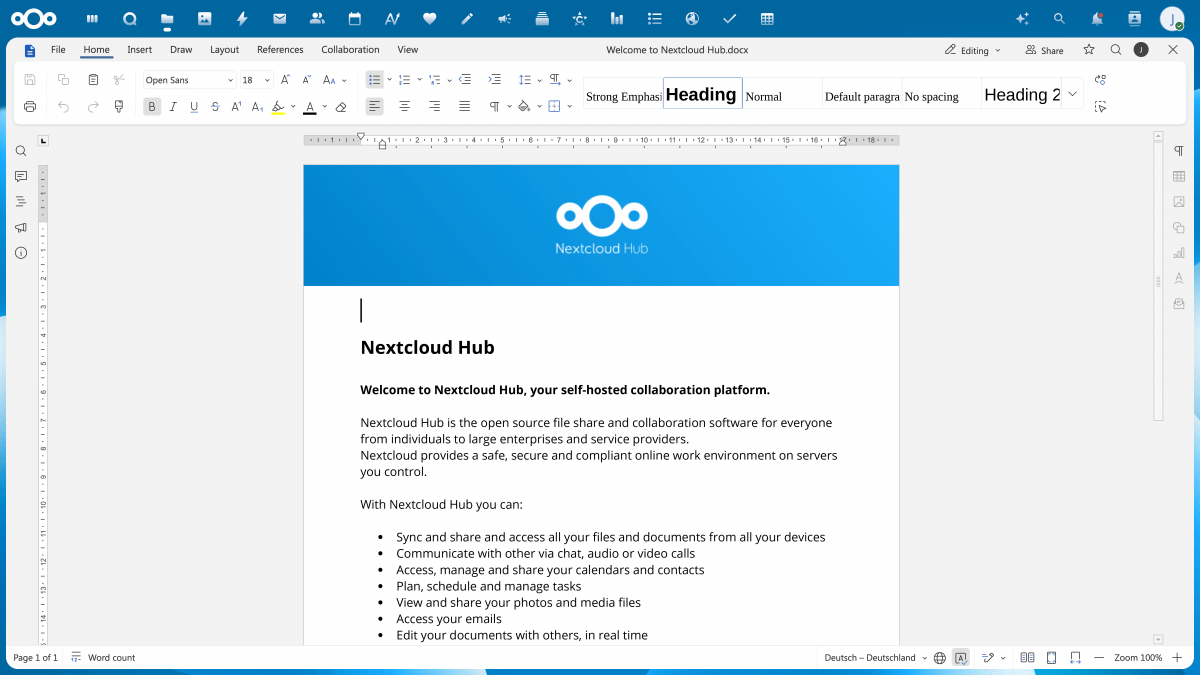
Nextcloud, Ionos and other partners are developing an open-source office suite under the project name „Euro-Office“ as an alternative to the market-dominant Microsoft Office.
The two partners are not starting from scratch, but have forked the components of OnlyOffice available as open-source code and want to build on them. In the summer, the software is then intended to replace the previous office component Collabora in Nextcloud and the Ionos Nextcloud Workspace. A ‘technical preview’ is already available on GitHub.
While this is a good news, I think they should move from github, you know microslop copilot…
Is python realistic for non tech people? I have a lot of databases across sharepoint but no real tech knowledge beyond basics.
It’s one of the friendliest programming languages around. If you have written something in VBA then you’ll do fine with Python, except for all the bad/outdated nonsense you’ll have picked up from that language. And there’s interactive interpreters you can just mess around in.
If this doesn’t scare you then give it a look:
things = [4, 8, 15, 16, 23, 42] for number in things: print(number * 16)it was partly made for mathematicians who did not know how to develop software, but also for education. so I guess it’s a good starter language. but it allows doing way too much things that will be very confusing when overused
If you are running multiple databases you are already a “tech people”
Sharepoint is not a “database”. Many people have made that mistake and it eventually comes back to bite you.
I would recommend learning SQL. It is made to be human readable, and we’ve been perfecting it since the 1960’s.
Python let you run SQL on any file, and standard DB technology with a very small number of lines of code. Recommend reading about Pandas
I would just have a lot of interdependent excels on sharepoint, think customer data and their respective equipment, serials, progression. I detest microsoft sooving away woupd be ideal and if I can do it while getting my head around python then great.
I have no idea what pandas is.
Python is a modular language, so it has various packages to do different things you need to do. Whether that’s math, graphing, database querying, language parsing, machine learning, or pretty much anything else you can think of, there’s probably a python package for it. You just need to install the package in addition to the basic python library, and import the packages you’re gonna use into your scripts.
Pandas is a python package commonly used for data analysis. Another one is Agate.
If you’re learning SQL, there’s a python package called SQLAlchemy that will enhance your database operations. Another one is Agate-SQL, which integrates with Agate. Both are interoperable with SQLite (for local storage) and PostgreSQL (for server-based setups).
NumPy and Numba are python packages used for most math operations, and there are various other packages for higher-level math in case you need to do linear algebra, matrix multiplications, tensor calculus, or whathaveyou.
Matplotlib and Plotly are used for graphing, and there are others with more advanced features like interactive data visualization.
These are just a few examples. If you’re in geoinformatics, astrophysics, cybersecurity, or just about anything else, there are python packages that will expand your toolkit.