I thought the same at first, but comparing to the map scale, I think that would mean the ship is crazy giant (like slightly bigger than the small loops in the track).
If you compare that to the islands, it would mean the ship is bigger than many islands.
Also, it would mean the ship is travelling slower than the man can run, which is possible, but not probable…
I’m not sure why it’s zigzagging, but I would bet it’s something else…
you can’t compare it to the islands, because the GPS trace is in an area within that green circle, with a different scale. You can only look at the 300m scale in the bottom right, which looks in the ballpark of an aircraft carrier to me
Wow. Can you infer vessel speed by assuming the run always concluded at the start position? The bottom line doesn’t meet back at the top line because the ship and runner were going in opposite directions.
You don’t need that assumption. Your assumption can just be “the person and vessel (or a point in the vessel, like its center of mass) don’t diverge significantly over time”.
Then, if you treat velocity as a vector and compute the person’s average velocity vector over time, you’ll have a pretty close estimation to the vessel’s velocity vector.
After all, if those two average vectors (vessel’s and person’s) were to differ much, they would end up in different locations.
The average basically zeroes the vector for each lap the person does, so the remainder must be the vessel’s.


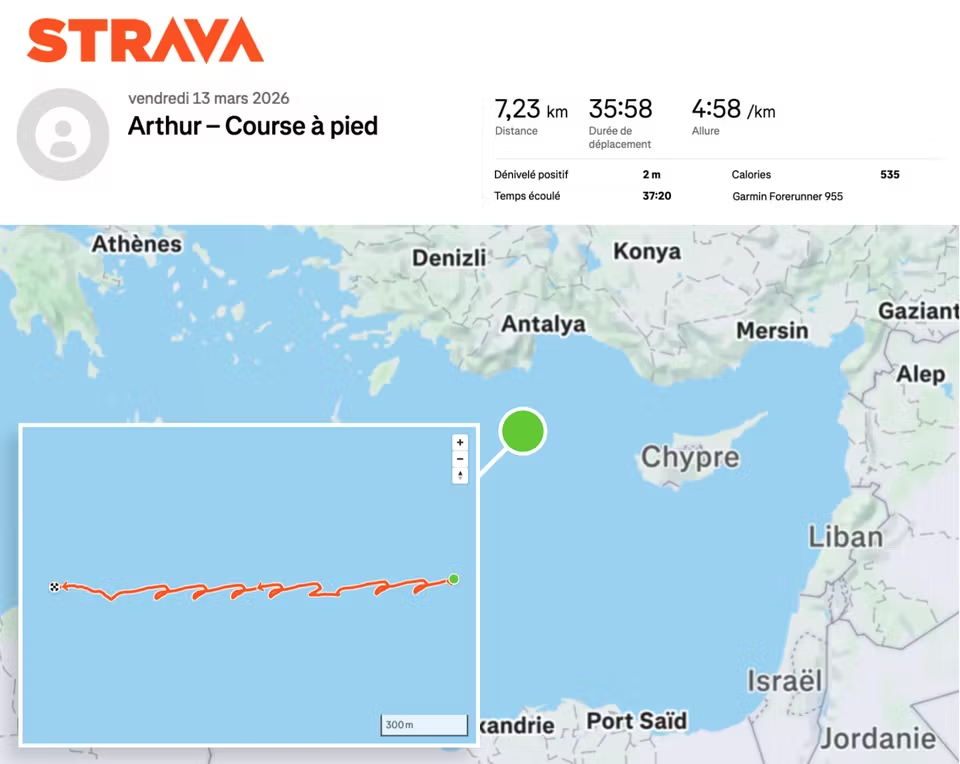
Why is it zig zagging?
that’s how it looks when you walk/run in circles in a vessel that’s moving
I thought the same at first, but comparing to the map scale, I think that would mean the ship is crazy giant (like slightly bigger than the small loops in the track). If you compare that to the islands, it would mean the ship is bigger than many islands.
Also, it would mean the ship is travelling slower than the man can run, which is possible, but not probable…
I’m not sure why it’s zigzagging, but I would bet it’s something else…
you can’t compare it to the islands, because the GPS trace is in an area within that green circle, with a different scale. You can only look at the 300m scale in the bottom right, which looks in the ballpark of an aircraft carrier to me
Wow. Can you infer vessel speed by assuming the run always concluded at the start position? The bottom line doesn’t meet back at the top line because the ship and runner were going in opposite directions.
You don’t need that assumption. Your assumption can just be “the person and vessel (or a point in the vessel, like its center of mass) don’t diverge significantly over time”.
Then, if you treat velocity as a vector and compute the person’s average velocity vector over time, you’ll have a pretty close estimation to the vessel’s velocity vector.
After all, if those two average vectors (vessel’s and person’s) were to differ much, they would end up in different locations.
The average basically zeroes the vector for each lap the person does, so the remainder must be the vessel’s.
He’s running up and down the deck