

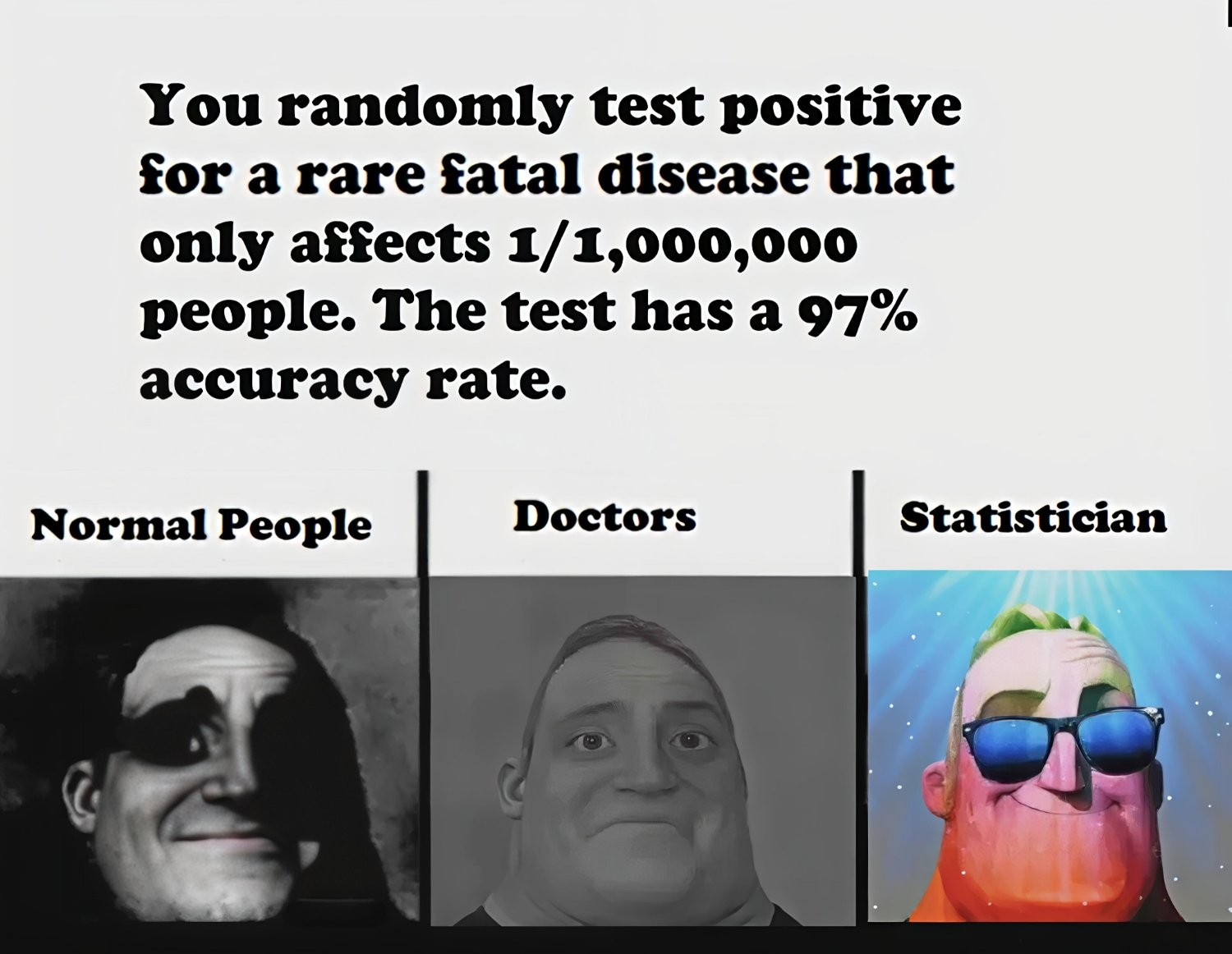
The meme is talking about a common probability error that surveys have shown even doctors are prone to making.
Why you’re probably ok:
The rarity of the disease far exceeds the error rate of the positive test. Meaning, the disease occurs in 1 out of a million people, so if you are tested at random and show positive, you only have a 1 out of 30,000 chance (the 3% false-positive rate) of being the the 1 person who truly has the disease.
Is 97% accuracy rate the same as a 3% false positive rate? It might be a combination of false positive and false negative rate.
Accuracy is defined in relation to a specific population or dataset with a specific rate of disease, not for any individual. To properly characterize the test, you need to know the specificity and sensitivity, and together they tell you how a test will perform on an individual and how much an individual’s pre-test probability increases in the case of a positive test or decreases based on a negative test.
Don’t worry if it’s confusing, Baysean statistics is often counter-intuitive.
If you’re interested, here is a very good 3Blue1Brown video that explains the concept very well.
Thank’s for the link. Probability and statistics in general is not intuitive to me, not just for this type.