Two important parts of a battery are how much energy it can store in a certain space and how much it weighs. If it is bigger and holds the same amount of energy that might be ok for a non mobile storage if it costs less, like a house. If it weighs more for a certain energy that wouldn’t be useful for cars and mobile things but might be ok for small things where the weight is negligible anyway. For cars you want a small energy dense battery that is light as possible
Downsizing metal nanoparticles into nanoclusters and single atoms represents a transformative approach to maximizing atom utilization efficiency for energy applications. Herein, a bovine serum albumin-templated synthetic strategy is developed to fabricate iron and nickel nanoclusters, which are subsequently hydrothermally composited with graphene oxide. Through KOH-catalyzed pyrolysis, the downsized metal nanoclusters and single atoms are embedded in a hierarchically porous protein/graphene-derived carbonaceous aerogel framework. The carbon-supported Fe subnanoclusters (FeSNC) as the negative electrode and Ni subnanoclusters (NiSNC) as the positive electrode exhibit remarkable specific capacitance (capacity) values of 373 F g−1 (93 mAh g−1) and 1125 F g−1 (101 mAh g−1) at 1.0 A g−1, respectively. Assembled into a supercapacitor-battery hybrid configuration, the device achieves an excellent specific energy (47 W h kg−1) and superior specific power (18 kW kg−1), while maintaining outstanding cycling stability of over 12 000 cycles. Moreover, FeSNCs displayed a significantly reduced oxygen evolution overpotential (η10 = 270 mV), outperforming the RuO2 benchmark (η10 = 328 mV). Molecular dynamics simulations, coupled with density functional theory calculations, offer insights into the dynamic behavior and electronic properties of these materials. This work underscores the immense potential of metallic subnanoclusters for advancing next-generation energy storage and conversion technologies.
Article says 47 Wh/kg. Thats around a third of LFP cells. But the power density is way higher. Meaning it can do enormous peak currents.
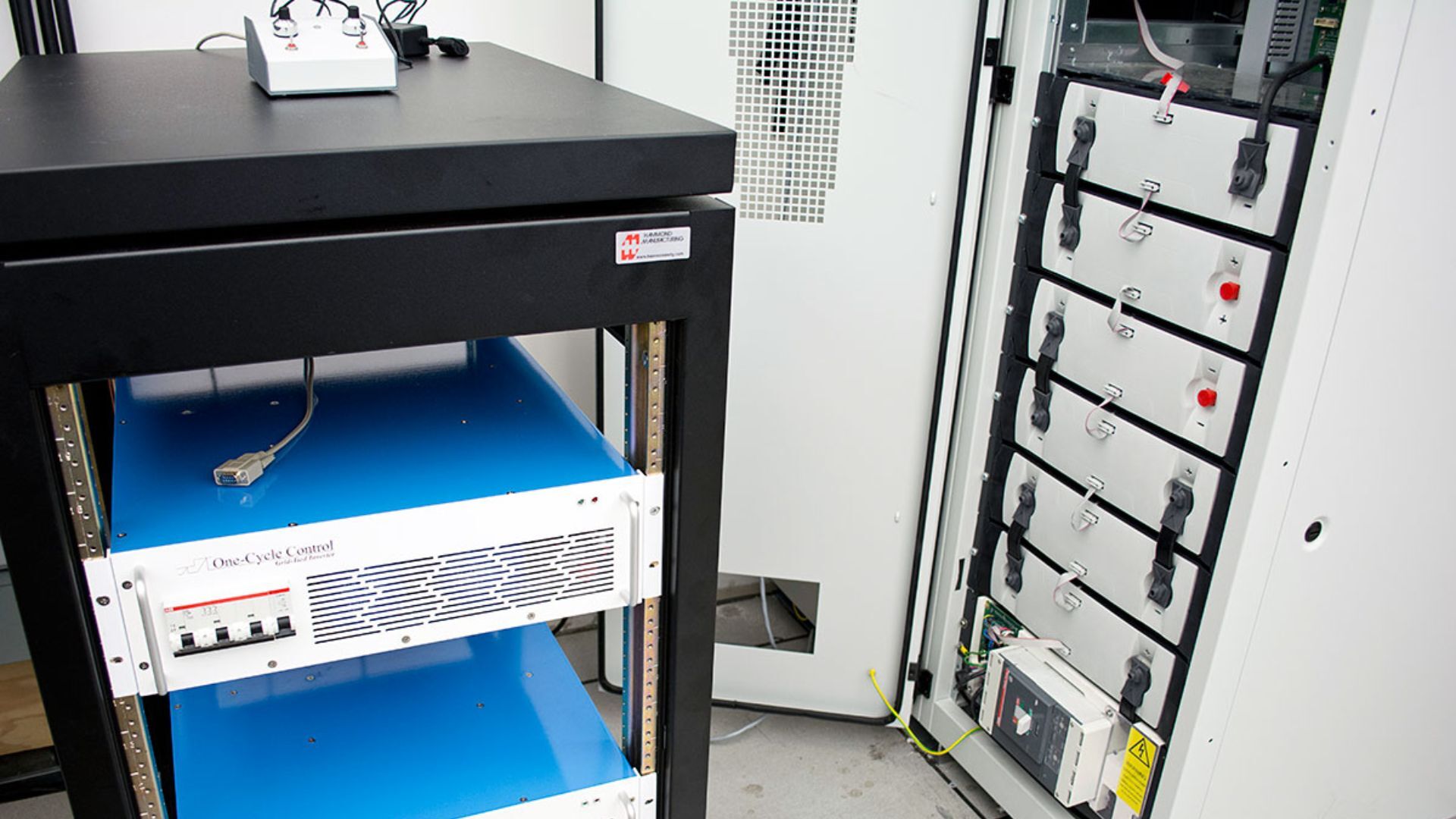
For grid energy storage, energy density is not the most important factor, but the power density is a great plus. It means these cells can rapidly charge or discharge in the grid, offering flexibility to buffer in any way that is required. And the cycle life is also way higher.


It would be good if you actually told us what that energy density is…
Technically, a copper wire is a battery that charges in (a very tiny fraction of ) seconds.
ahkshuallly, don’t you mean a capacitor?
About tree fiddy
Ah said MONSTAH!
Two important parts of a battery are how much energy it can store in a certain space and how much it weighs. If it is bigger and holds the same amount of energy that might be ok for a non mobile storage if it costs less, like a house. If it weighs more for a certain energy that wouldn’t be useful for cars and mobile things but might be ok for small things where the weight is negligible anyway. For cars you want a small energy dense battery that is light as possible
Abstract
Downsizing metal nanoparticles into nanoclusters and single atoms represents a transformative approach to maximizing atom utilization efficiency for energy applications. Herein, a bovine serum albumin-templated synthetic strategy is developed to fabricate iron and nickel nanoclusters, which are subsequently hydrothermally composited with graphene oxide. Through KOH-catalyzed pyrolysis, the downsized metal nanoclusters and single atoms are embedded in a hierarchically porous protein/graphene-derived carbonaceous aerogel framework. The carbon-supported Fe subnanoclusters (FeSNC) as the negative electrode and Ni subnanoclusters (NiSNC) as the positive electrode exhibit remarkable specific capacitance (capacity) values of 373 F g−1 (93 mAh g−1) and 1125 F g−1 (101 mAh g−1) at 1.0 A g−1, respectively. Assembled into a supercapacitor-battery hybrid configuration, the device achieves an excellent specific energy (47 W h kg−1) and superior specific power (18 kW kg−1), while maintaining outstanding cycling stability of over 12 000 cycles. Moreover, FeSNCs displayed a significantly reduced oxygen evolution overpotential (η10 = 270 mV), outperforming the RuO2 benchmark (η10 = 328 mV). Molecular dynamics simulations, coupled with density functional theory calculations, offer insights into the dynamic behavior and electronic properties of these materials. This work underscores the immense potential of metallic subnanoclusters for advancing next-generation energy storage and conversion technologies.
Article says 47 Wh/kg. Thats around a third of LFP cells. But the power density is way higher. Meaning it can do enormous peak currents.
For grid energy storage, energy density is not the most important factor, but the power density is a great plus. It means these cells can rapidly charge or discharge in the grid, offering flexibility to buffer in any way that is required. And the cycle life is also way higher.
It sounds like a great option for hybrid vehicle batteries, in that case. They still use NI-MH batteries a lot of the time.