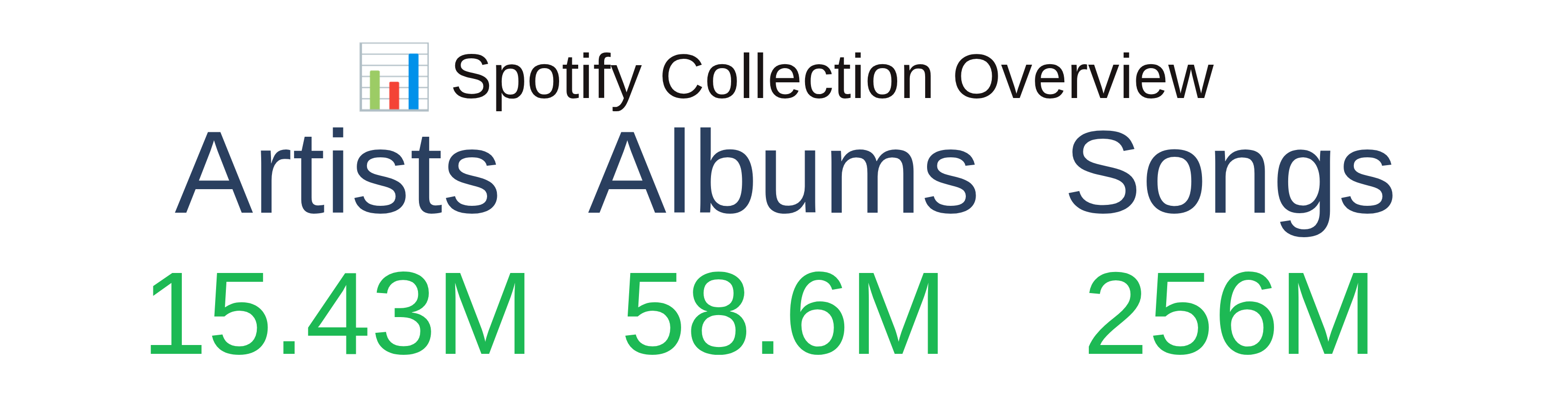
We backed up Spotify (metadata and music files). It’s distributed in bulk torrents (~300TB). It’s the world’s first “preservation archive” for music which is fully open (meaning it can easily be mirrored by anyone with enough disk space), with 86 million music files, representing around 99.6% of listens.


Perhaps I’m reading this wrong, but is this not a little backwards? Since unpopular music is poorly preserved, shouldn’t the focus be on getting the least popular music first?
Unfortunately if you sort by least popular musicon Spotify, you’ll get nothing but spam
It depends on what your goal is: If you want to preserve the music that is important to most people or to the era, you should start with the most popular stuff. And Spotify has a big spam problem. Everybody who thinks he is a DJ wants his music to be on there and there is so much AI music flooding the scene. So it does make sense to backup what people are actually listening and not some AI-generated music spam nobody cares about.
I mean, they say earlier that music is actually well-preserved, but it’s disproportionately popular music. If the goal is then to preserve everything, I’d expect them to go for stuff that isn’t likely to be in some random audiophile’s collection or whatever then.
I am pretty sure the major labels are already preserving the most mainstream artists. Msybe it should be sorting by the most popular independent artists
The politics of preservation is definitely an interesting one. I suppose one argument in favor of preserving more popular music is that there are going to be fewer popular tracks than unpopular tracks - and they’re already at 300TB, which is nothing to sneeze at, especially since it’s a third the size of their existing library of ebooks.
If we were talking about the ethnic music of an extinct tribe that uses a language on risk of disappearing, sure, you would be right.
But think about it for a bit longer. They are just a commercial production that had no cultural impact in a population. They are still getting preserved in a format with a quality degradation that is imperceptible to the human ear. That’s usually enough. Audiophiles are usually overzealous about fidelity preservation. But the efforts are often misguided and discussions abound on technical topics that ultimately don’t matter.
If you want that long tail, bandcamp and soundcloud are better sources. The barrier to entry is low with those, and there’s a plethora of small, niche artists just doing their own thing.
For a representative snapshot of music though, it’s pretty amazing. It shows what a massive percentage of the planet listens to, preserved hopefully across many seeds, and historians will love shit like this in the future.
I agree. I seed torrents/files that took me a long time to finish.