I know what they’re referring to. And I’m saying that if you use keyboards enough, you will naturally develop the muscle memory required for touch typing.
As someone who developed muscle memory on keyboards from 4-6, and then had to unlearn that muscle memory when I was doing touch typing classes, it is just not true that you naturally acquire the muscle memory for touch typing through typing practice.
It’s a formal skill that has to be practiced deliberately to develop.
Hybrid typists can definitely hit high WPM but unless they’re learning to type using the 8 horizontal homerow keys it’s not touch typing. It really is a specific technique.
(I did not downvote you, just adding to the conversation.)
There is no significant difference in WPM or accuracy between people who were self-taught, and those who had formal education. Refusing to call it touch typing, simply because it isn’t using a specific technique, is pedantic at best.
The term “touch typing” is not a generic term for typing at any particular speed, or for typing with or without looking at the keys. It refers to a specific typing technique in which specific fingers are used for specific keys. Referring to the term correctly is not pedantry or elitism. I don’t think anyone is arguing that another technique is inferior, or that it is in any way not typing, only that it is, in fact, different from the specific typing technique referred to as “touch typing”.
In a similar vein, a self-taught fighter could potentially be more skilled than one with some training in Taekwondo. That doesn’t mean that the self-taught fighter is using Taekwondo, and pointing out that difference is not “pedantic at best”; it’s simply correct.
Language doesn’t work like that. In professional and educational contexts? Yeah, it’ll likely refer to a specific technique. But in general? Absolutely not. I’m calling it pedantic because the technique is just that - a technique. I’m not claiming that it has anything to do with skill, WPM, or accuracy, just that they’re the same in those regards. On that point, your analogy doesn’t really work for me, since we have very different views on the topic. You think touch typing is only a specific technique, whereas I think it has a less restrictive definition, certainly in everyday use. To use the same analogy, for me it’s like you’re saying only it’s only Taekwondo if it’s a specific style of Taekwondo.
So, if I’m understanding you correctly, you’re coming upon others who agree with my assertion that the term “touch typing” refers to a specific technique for typing, and using the term to refer to that specific technique, and your response is to call them pedantic because you think the term should be defined more broadly than they (or I) understand it to be defined. Is that correct?
As for the issue you point out with my analogy, I think one of us is confused, and I’m not attempting to imply that I know which one. I used the analogy because touch typing is a specific technique for typing, just as Taekwondo is a specific type of martial arts. A self-taught fighter would be analogous to a self-taught typist. If you believe the term “touch typing” absolutely cannot refer to a specific typing technique, then I would ask for the term you believe is correct to refer to that specific technique to which the rest of us are referring. I’m fine with using a different term to refer to the technique to which I am attempting to refer, but “touch typing” is the only one I know. If you know another, please provide it, and I’ll use that.
I’m not the one who started this discussion on what touch typing means, I’ve just given my view on it. Perhaps I could’ve phrased it more softly, but I won’t deny it’s what I think. And again, I agree with your assertion, but only when specificity is actually required. Otherwise, if you’re going to claim, outside of those contexts, that touch typing only refers to a specific technique, then yes, I think you are being pedantic.
EDIT:
Since I replied to your initial comment, I’ll update this one too. There definitely is some confusion with regard to your analogy. The point I was trying to make is that while Taekwondo is a type of martial art, it has different styles. From my point of view, you think only a specific style meets the definition of Taekwondo, and all others are something else entirely. If I were to choose a different name, I’d say something like 10-finger, or the home row technique. But I’m not going to try and force you to use any term other than what you want to use. I just have my own opinion on when it’s appropriate to be strict and precise in its definition.
The point is that I and others are clearly attempting to refer to a specific technique, even if we’re doing so using a term with which you disagree. If you dislike us using the term we’re using, then please provide an alternate term that we can use to refer to the specific technique. Otherwise, how are we to discuss said specific technique without giving offense?
My man, I’m not insecure at all. Why would I be? I don’t think one technique is any better, or worse, than another, and I’m happy enough with my typing ability. What I don’t like, is people being childish and resorting to mockery when people are trying to have a discussion.
It’s a topic I have a lot of interest in, so of course I’m going to discuss it if the opportunity presents itself, especially if I disagree with what’s been said. If you yourself don’t care about the discussion, why did you bother joining it? And I’ve tried being civil, can you say the same about your childish message?
If you type enough you will certainly be able to do so without looking, but its surely undeniable that someone who has practiced a specific technique will be faster, and more accurate, particularly with punctuation and special characters.
No, they won’t. The specific technique is just a standardised way of educating people. It isn’t inherently better than a technique that an individual has developed on their own. Might the specific technique be more efficient in terms of movement? Perhaps. But if someone has found a technique that works for them, it might also be what’s most efficient for them. But in terms of speed and accuracy? They’re the same.
I learnt to “type” when I was at school, programming a Commodore Vic-20. I thought I was quite fast, but what I had really learnt was just the key combos for common words. It’s what most people who have never learnt properly before do, and it’s called “point and poke”. You don’t realise the extra effort you’re putting in, and the mistakes you’re making (overuse of the backspace key) and so on.
When I went to college at 16 (UK) to study computer science, we had the option of learning touch typing. We all thought we were pretty good at typing, but afterwards, we’d all doubled our typing speed (or more) and increased our accuracy by 10x. We learnt on proper electric golfball typewriters, and as we got better, we all noticed that code entry got a lot faster. The thing that is affected most, though, is typing up from notes or printed copy - because you don’t have to keep looking away from the source, back to the keyboard and screen, you can be much quicker. Also, typing your thoughts is much faster as you are not having to split your attention between the thoughts and the keyboard - what you think just appears on the screen without having to spend mental effort on typing.
I feel like we’re talking about two different things. Touch typing, regardless of the technique used, only implies looking away from the keyboard. If you’ve got the muscle memory, and instinctively know where keys are, whether that’s through technique or reinforced familarity, you can look wherever you want.
Yeah, you and all the people you’re responding to are talking about different things.
They’re talking about touch typing, a noun with a specific definition and meaning referring to a technique, instructional method and practice and you’re talking about what you think words should mean.


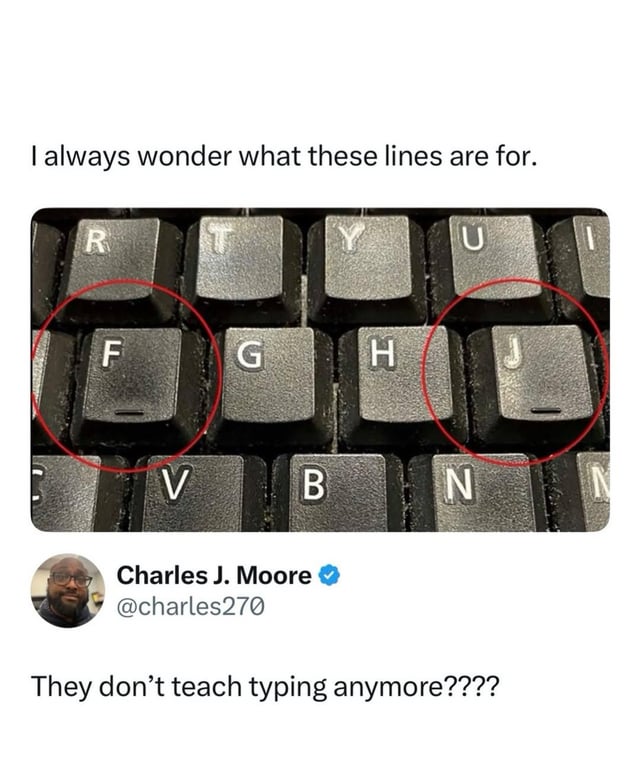
I know what they’re referring to. And I’m saying that if you use keyboards enough, you will naturally develop the muscle memory required for touch typing.
As someone who developed muscle memory on keyboards from 4-6, and then had to unlearn that muscle memory when I was doing touch typing classes, it is just not true that you naturally acquire the muscle memory for touch typing through typing practice.
It’s a formal skill that has to be practiced deliberately to develop.
Hybrid typists can definitely hit high WPM but unless they’re learning to type using the 8 horizontal homerow keys it’s not touch typing. It really is a specific technique.
(I did not downvote you, just adding to the conversation.)
There is no significant difference in WPM or accuracy between people who were self-taught, and those who had formal education. Refusing to call it touch typing, simply because it isn’t using a specific technique, is pedantic at best.
The term “touch typing” is not a generic term for typing at any particular speed, or for typing with or without looking at the keys. It refers to a specific typing technique in which specific fingers are used for specific keys. Referring to the term correctly is not pedantry or elitism. I don’t think anyone is arguing that another technique is inferior, or that it is in any way not typing, only that it is, in fact, different from the specific typing technique referred to as “touch typing”.
In a similar vein, a self-taught fighter could potentially be more skilled than one with some training in Taekwondo. That doesn’t mean that the self-taught fighter is using Taekwondo, and pointing out that difference is not “pedantic at best”; it’s simply correct.
it is generic
it is clearly descriptive
find a better term to call it
We all voted on it, did you miss election day?
Language doesn’t work like that. In professional and educational contexts? Yeah, it’ll likely refer to a specific technique. But in general? Absolutely not. I’m calling it pedantic because the technique is just that - a technique. I’m not claiming that it has anything to do with skill, WPM, or accuracy, just that they’re the same in those regards. On that point, your analogy doesn’t really work for me, since we have very different views on the topic. You think touch typing is only a specific technique, whereas I think it has a less restrictive definition, certainly in everyday use. To use the same analogy, for me it’s like you’re saying only it’s only Taekwondo if it’s a specific style of Taekwondo.
So, if I’m understanding you correctly, you’re coming upon others who agree with my assertion that the term “touch typing” refers to a specific technique for typing, and using the term to refer to that specific technique, and your response is to call them pedantic because you think the term should be defined more broadly than they (or I) understand it to be defined. Is that correct?
As for the issue you point out with my analogy, I think one of us is confused, and I’m not attempting to imply that I know which one. I used the analogy because touch typing is a specific technique for typing, just as Taekwondo is a specific type of martial arts. A self-taught fighter would be analogous to a self-taught typist. If you believe the term “touch typing” absolutely cannot refer to a specific typing technique, then I would ask for the term you believe is correct to refer to that specific technique to which the rest of us are referring. I’m fine with using a different term to refer to the technique to which I am attempting to refer, but “touch typing” is the only one I know. If you know another, please provide it, and I’ll use that.
I’m not the one who started this discussion on what touch typing means, I’ve just given my view on it. Perhaps I could’ve phrased it more softly, but I won’t deny it’s what I think. And again, I agree with your assertion, but only when specificity is actually required. Otherwise, if you’re going to claim, outside of those contexts, that touch typing only refers to a specific technique, then yes, I think you are being pedantic.
EDIT: Since I replied to your initial comment, I’ll update this one too. There definitely is some confusion with regard to your analogy. The point I was trying to make is that while Taekwondo is a type of martial art, it has different styles. From my point of view, you think only a specific style meets the definition of Taekwondo, and all others are something else entirely. If I were to choose a different name, I’d say something like 10-finger, or the home row technique. But I’m not going to try and force you to use any term other than what you want to use. I just have my own opinion on when it’s appropriate to be strict and precise in its definition.
The point is that I and others are clearly attempting to refer to a specific technique, even if we’re doing so using a term with which you disagree. If you dislike us using the term we’re using, then please provide an alternate term that we can use to refer to the specific technique. Otherwise, how are we to discuss said specific technique without giving offense?
I edited my reply after I saw your edit.
LOL
Your typing is inferior.
How does that make you feel?
It makes me feel sorry for your apparent idiocy.
You seem a little insecure about it.
My man, I’m not insecure at all. Why would I be? I don’t think one technique is any better, or worse, than another, and I’m happy enough with my typing ability. What I don’t like, is people being childish and resorting to mockery when people are trying to have a discussion.
You just seem unreasonably vociferous about this particular “discussion”.
So some people think typing is a special learned skill. Who cares? You aparently.
It’s a topic I have a lot of interest in, so of course I’m going to discuss it if the opportunity presents itself, especially if I disagree with what’s been said. If you yourself don’t care about the discussion, why did you bother joining it? And I’ve tried being civil, can you say the same about your childish message?
I dont think thats necessarily true.
If you type enough you will certainly be able to do so without looking, but its surely undeniable that someone who has practiced a specific technique will be faster, and more accurate, particularly with punctuation and special characters.
No, they won’t. The specific technique is just a standardised way of educating people. It isn’t inherently better than a technique that an individual has developed on their own. Might the specific technique be more efficient in terms of movement? Perhaps. But if someone has found a technique that works for them, it might also be what’s most efficient for them. But in terms of speed and accuracy? They’re the same.
I learnt to “type” when I was at school, programming a Commodore Vic-20. I thought I was quite fast, but what I had really learnt was just the key combos for common words. It’s what most people who have never learnt properly before do, and it’s called “point and poke”. You don’t realise the extra effort you’re putting in, and the mistakes you’re making (overuse of the backspace key) and so on.
When I went to college at 16 (UK) to study computer science, we had the option of learning touch typing. We all thought we were pretty good at typing, but afterwards, we’d all doubled our typing speed (or more) and increased our accuracy by 10x. We learnt on proper electric golfball typewriters, and as we got better, we all noticed that code entry got a lot faster. The thing that is affected most, though, is typing up from notes or printed copy - because you don’t have to keep looking away from the source, back to the keyboard and screen, you can be much quicker. Also, typing your thoughts is much faster as you are not having to split your attention between the thoughts and the keyboard - what you think just appears on the screen without having to spend mental effort on typing.
I feel like we’re talking about two different things. Touch typing, regardless of the technique used, only implies looking away from the keyboard. If you’ve got the muscle memory, and instinctively know where keys are, whether that’s through technique or reinforced familarity, you can look wherever you want.
Yeah, you and all the people you’re responding to are talking about different things.
They’re talking about touch typing, a noun with a specific definition and meaning referring to a technique, instructional method and practice and you’re talking about what you think words should mean.