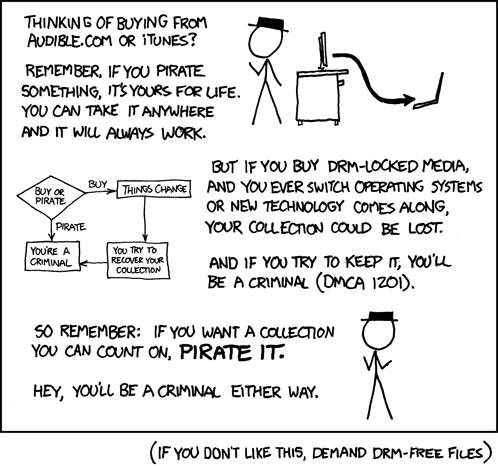
camilobotero@feddit.dk to Piracy: ꜱᴀɪʟ ᴛʜᴇ ʜɪɢʜ ꜱᴇᴀꜱ@lemmy.dbzer0.comEnglish · 1 year agoSteal This Comicxkcd.comexternal-linkmessage-square72fedilinkarrow-up1584arrow-down13file-textcross-posted to: [email protected]
arrow-up1581arrow-down1external-linkSteal This Comicxkcd.comcamilobotero@feddit.dk to Piracy: ꜱᴀɪʟ ᴛʜᴇ ʜɪɢʜ ꜱᴇᴀꜱ@lemmy.dbzer0.comEnglish · 1 year agomessage-square72fedilinkfile-textcross-posted to: [email protected]
minus-squareLainTrain@lemmy.dbzer0.comlinkfedilinkEnglisharrow-up4arrow-down1·1 year ago256kbps AAC is still proprietary, but you can convert it to an MP3 with something like dBPowerAmp
minus-squareProgrammingSocks@pawb.sociallinkfedilinkEnglisharrow-up13arrow-down1·edit-21 year agoDon’t do this. You will lose quality every time you re-transcode an audio file. AAC is supported by basically everything now. Also MP3 is a pretty bad format all things considered. The most efficient format is Opus, it’s open source and transparent at 160kbps.
minus-squareWolfLink@sh.itjust.workslinkfedilinkEnglisharrow-up3arrow-down2·1 year agoHow is AAC proprietary?
minus-squaregrey_maniac@lemmy.calinkfedilinkEnglisharrow-up5·1 year agoAdvanced Audio Coding (AAC) is patented and requires a license for legal use.
minus-squareWolfLink@sh.itjust.workslinkfedilinkEnglisharrow-up2arrow-down2·1 year agoI mean so is MP3. If you really want to be a non-proprietary purist you need to rely on Opus for a lossy audio compression, which is not as widely supported in music players as MP3 or AAC.


256kbps AAC is still proprietary, but you can convert it to an MP3 with something like dBPowerAmp
Don’t do this. You will lose quality every time you re-transcode an audio file. AAC is supported by basically everything now.
Also MP3 is a pretty bad format all things considered. The most efficient format is Opus, it’s open source and transparent at 160kbps.
How is AAC proprietary?
Advanced Audio Coding (AAC) is patented and requires a license for legal use.
I mean so is MP3. If you really want to be a non-proprietary purist you need to rely on Opus for a lossy audio compression, which is not as widely supported in music players as MP3 or AAC.
MP3’s licenses and patents have expired.